
Featured image | A leadership team reviewing a cyber incident response plan in a modern UK workplace.
By the Cyber Resilience, Risk and Business Protection Faculty 19 August 2026
A suspicious payment request reaches a finance colleague at 16:47 on a Friday. The technology controls have done their work up to a point, but the decisive question is human: does the colleague pause, verify and escalate, or act quickly to clear the task? That moment explains why organisations asking how to build cyber resilience need more than security software, annual awareness modules or an incident plan stored in a shared drive.
Cyber resilience is the organisation’s capacity to anticipate threats, withstand disruption, respond with discipline and recover without losing confidence in its decisions. It joins technical security to leadership judgement, operational continuity and everyday professional habits. The objective is not a claim that a business cannot be compromised. It is the ability to continue operating with control when something goes wrong.
Key takeaways
- Cyber resilience is a governance and performance capability, not solely an IT responsibility.
- Clear decision rights reduce delay and confusion during a live incident.
- Teams need rehearsed behaviours for recognising, reporting and containing suspicious activity.
- Recovery plans must protect critical services, data integrity and stakeholder trust.
- Short, role-relevant learning is more likely to transfer into daily practice than generic compliance training.
Table of contents
- What cyber resilience means in practice
- Set governance before selecting interventions
- Build resilient habits across the workforce
- Design response and recovery for real operating conditions
- Measure whether capability is improving
- Frequently asked questions
What cyber resilience means in practice
Cyber security is often discussed as prevention: stopping unauthorised access, blocking malicious software and reducing exposure. These controls remain essential. Cyber resilience takes a wider view. It assumes that disruption may occur through a supplier, a compromised account, human error, an unavailable system or a targeted attack.
For leadership teams, the distinction matters. A secure organisation may have strong controls but still struggle to make decisions when systems fail. A resilient organisation has prepared its people, governance and operating processes to manage uncertainty without improvising critical choices.
This is especially relevant in professional services, regulated environments and organisations dependent on digital workflows. A short outage can become a material business event if teams cannot identify priority services, communicate consistently or establish whether data can be trusted.
How to build cyber resilience through governance
The starting point is to define what must continue. Not every system, dataset or process carries the same consequence. Senior leaders should identify critical services, the dependencies behind them and the acceptable period of disruption for each. This establishes a meaningful basis for investment and recovery planning.
Governance then needs to answer practical questions before an incident occurs. Who can take a service offline? Who decides whether clients, regulators or insurers should be notified? Who owns the business decision when technology evidence remains incomplete? A policy that assigns broad accountability without clear decision rights creates delay precisely when speed and control are required.
Cyber risk should be reviewed alongside operational, financial and reputational risk, rather than treated as a separate technical report. The board does not need a catalogue of alerts. It needs visibility of material exposures, readiness assumptions, unresolved dependencies and the organisation’s ability to recover priority services.
There is a trade-off. Overly centralised approval can slow urgent containment; overly distributed authority can result in inconsistent action. The appropriate model depends on organisational size, regulation and operating complexity. The principle is consistent: authority must be explicit, understood and practised.
Build resilient habits across the workforce
Most cyber decisions are made in ordinary working conditions: when a colleague is busy, a request appears credible and a deadline feels pressing. Training therefore has to improve judgement under pressure, not merely increase familiarity with terminology.
Effective learning is role-specific. Finance teams may need to verify changes to bank details and payment instructions. HR teams handle sensitive personal data and need disciplined controls around access, disclosure and retention. Leaders need to understand escalation thresholds, communication responsibilities and the consequences of informal workarounds during disruption.
A useful programme gives people a small number of repeatable actions: pause when an instruction changes unexpectedly, verify through a known channel, report promptly and preserve evidence. These behaviours should be reinforced through realistic scenarios, team discussion and clear local procedures. The aim is a shared operating language, not a one-off awareness event.
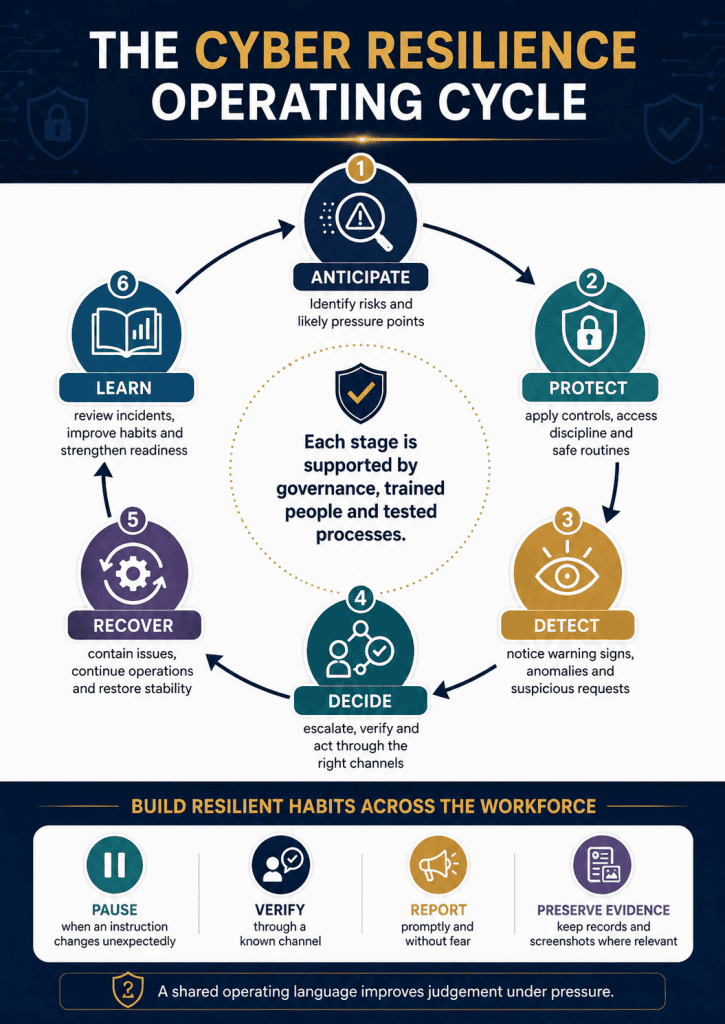
Managers have a particular role. Their response to a reported concern teaches the team whether escalation is valued. If employees fear blame for raising a false alarm, warnings will arrive late. A mature culture treats early reporting as sound professional judgement, even where the concern proves harmless.
For organisations seeking a structured starting point, a focused 90-minute briefing can establish common language, clarify individual responsibilities and expose the decisions that require further work. It is not a substitute for technical remediation or exercise programmes. It can, however, provide a disciplined entry point for teams whose understanding is fragmented.
Design response and recovery for real operating conditions
An incident response plan is useful only if it works when information is incomplete and time is constrained. Plans should define the first actions required to contain an event, preserve evidence, bring together the right decision-makers and maintain a reliable record of choices made.
Recovery requires equal attention. Restoring a system quickly is not enough if the underlying data has been altered, customer communications are inconsistent or staff return to unsafe workarounds. Organisations should specify the conditions that must be met before services are considered safe to resume, including data validation, access reviews and accountable sign-off.
Exercises are where assumptions become visible. A well-designed scenario might begin with a compromised executive account, a ransomware alert affecting a key supplier or suspected exposure of employee data. It should test the interaction between IT, legal, communications, HR, operations and senior leadership. The quality of the discussion matters more than theatrical complexity.
After every exercise or incident, capture what changed. Which decision took too long? Which contact details were unreliable? Which dependency had not been recognised? This learning loop is central to resilience. A plan that is never revised becomes an archive rather than a control.
Measure whether capability is improving
Cyber resilience cannot be measured by completion rates alone. Attendance may show reach, but it says little about whether people can apply judgement when faced with a convincing threat.
A balanced view combines technical and organisational evidence. Leadership teams can examine reporting patterns, phishing simulation outcomes, time to contain incidents, recovery against agreed targets, exercise findings and the rate at which corrective actions are closed. They should also assess decision quality: whether escalation happened at the right point, whether responsibilities were clear and whether communications protected confidence.
Metrics need interpretation. An increase in reported suspicious emails may indicate rising risk, but it may equally indicate that staff are becoming more alert and willing to report. The question is not whether every measure moves in one preferred direction. It is whether the organisation is becoming better able to see, decide and act.
The most credible programmes are integrated with wider leadership and performance development. Under pressure, cognitive overload, unclear priorities and poor communication can weaken even well-designed controls. Cyber resilience improves when the organisation develops both technical safeguards and the professional discipline to use them properly.
Frequently asked questions
What is cyber resilience?
Cyber resilience is an organisation’s ability to prevent, withstand, respond to and recover from cyber disruption while protecting critical services, decisions and stakeholder confidence.
Is cyber resilience the same as cyber security?
No. Cyber security focuses strongly on reducing the likelihood of compromise. Cyber resilience includes security controls, but also covers leadership, continuity, communication, incident response and recovery.
Who is responsible for cyber resilience?
Responsibility is shared. Technology teams manage many controls, while leaders set priorities and governance. Every employee has a role in recognising concerns, following procedures and escalating promptly.
How often should cyber incident plans be tested?
The appropriate frequency depends on risk, regulatory duties and organisational change. At a minimum, plans should be reviewed regularly and exercised whenever critical systems, suppliers or operating arrangements change materially.
What should staff do if they suspect a cyber incident?
They should stop interacting with the suspicious item where safe to do so, use the agreed reporting route and avoid deleting evidence. Fast reporting is generally more valuable than trying to investigate alone.
Can a 90-minute briefing improve cyber resilience?
A briefing can improve shared understanding, highlight decision points and establish practical behaviours. It should sit within a wider programme that includes appropriate controls, tested processes and accountable governance.
Cyber resilience is built in the ordinary moments before a major event: the challenge to an unusual request, the manager who welcomes escalation, the leader who has already agreed who decides what. Those moments are where organisational protection becomes a practical capability rather than a statement of intent.
Authoritative UK guidance and further reading
The principles discussed in this guide should be considered alongside current UK Government and National Cyber Security Centre (NCSC) guidance. The following resources provide further practical guidance on cyber governance, organisational resilience, security culture and incident preparedness.
NCSC Cyber Assessment Framework (CAF)
A structured framework for assessing how effectively an organisation manages cyber security and resilience. It covers governance, risk management, protection, detection, response and recovery.
NCSC Cyber Security Culture Principles
Guidance for leaders and cyber security professionals on creating organisational conditions that encourage secure behaviour, openness, reporting and shared responsibility for cyber security.
NCSC Exercise in a Box
A free NCSC resource that enables organisations to rehearse their response to realistic cyber incidents through structured exercises and discussion.
UK Government Cyber Governance Code of Practice
Government guidance for boards and directors setting out the key actions senior leaders should take to govern cyber risk effectively and strengthen organisational resilience.
UK Government Cyber Resilience Pledge
The Government’s voluntary Cyber Resilience Pledge sets out practical actions organisations can take to demonstrate commitment to stronger cyber security and resilience.
These external resources are provided for further reading and should be consulted directly for the latest official guidance.


Leave a Reply