
Featured Image | A senior professional reviewing priorities before a high-stakes team meeting
Date: 13 September 2026 Author: MindWorks PRO® Performance Faculty
A calendar may show a full working day, yet it rarely shows the cognitive cost of that day: interrupted attention, competing decisions, ambiguous information, difficult conversations and the pressure to respond before thinking is complete. Cognitive training tools for professionals are valuable when they address that operational reality, rather than offering a short-lived test of memory or a generic promise of sharper thinking.
For organisations, the question is not whether staff can complete another digital exercise. It is whether they can consistently apply better attention, judgement and recovery practices where performance matters: before a client meeting, during an escalation, when evaluating risk, or after sustained periods of demand. The most useful tools are therefore structured, repeatable and connected to the work itself.
Key takeaways
- Cognitive training has most value when it improves decisions and behaviour in real professional contexts.
- Attention management, decision discipline, reflective practice and recovery should work together, not sit as disconnected activities.
- A tool without a shared language, managerial reinforcement and a clear use case is unlikely to transfer into daily work.
- Digital exercises can support development, but they should not be confused with proven workplace capability.
Table of contents
- What cognitive training should mean at work
- The tools that support professional performance
- Selecting tools with governance and intent
- Turning individual practice into team capability
- Frequently asked questions
What cognitive training should mean at work
Professional cognitive performance is not a single attribute. A leader can be highly knowledgeable yet make poor judgements when fatigued, rushed or attached to an early assumption. A technical specialist can concentrate deeply yet struggle to shift attention when priorities change. A commercially capable team can make sound individual decisions while still creating collective risk if no one tests the underlying reasoning.
This is why cognitive training should be defined by observable workplace outcomes. Can people identify the critical issue before reacting? Can they distinguish evidence from interpretation? Can they hold a clear line of thought in a pressured conversation? Can they recover sufficiently to remain reliable over time?
The distinction matters because many products market cognitive improvement through scores, puzzles or game-like tasks. These may be engaging, and some can be useful for practising a narrow skill. However, a higher score inside a tool does not automatically mean better judgement in a boardroom, safer decisions in a cyber incident, or clearer leadership during organisational change. Transfer is the standard that matters.
A framework-led approach treats cognition as part of professional practice. It combines individual techniques with routines, language and decision structures that teams can use under normal working conditions. In the MindWorks PRO® framework, this means treating focus, clarity, decision-making, resilience and sustainable performance as connected capabilities.
Cognitive training tools that support professional performance
The right combination depends on the role, risk profile and operating environment. A team managing rapid operational decisions needs different support from a leadership group working through complex stakeholder conflict. Nevertheless, several categories repeatedly prove useful when they are applied with discipline.
Attention and priority tools
Attention is not simply the ability to concentrate for longer. It is the ability to direct attention deliberately, protect it where necessary and redirect it when circumstances change. Practical tools include priority-setting protocols, protected thinking windows, interruption rules and short pre-meeting preparation prompts.
For example, a two-minute priority check before a meeting can establish the decision required, the information that matters and the contribution each attendee is expected to make. The technique is modest, but it can reduce conversational drift and prevent meetings from becoming a substitute for thought.
The trade-off is that strict focus routines can become unhelpful in highly responsive roles. Customer-facing, incident-response and senior leadership work often requires availability. In these settings, the objective is not to eliminate interruption but to establish clear thresholds for what deserves immediate attention.
Decision-quality tools
Sound decision-making benefits from a visible process, especially when teams face uncertainty. Decision logs, assumption checks, pre-mortems and structured challenge questions all make reasoning easier to examine. They slow down the specific moments that deserve more thought, without creating unnecessary bureaucracy around routine choices.
A useful decision log records the decision, the available evidence, the assumptions made, the owner and the review point. It creates organisational memory and makes learning possible when outcomes are later assessed. For regulated, high-risk or rapidly changing environments, this basic discipline can also strengthen governance.
Pre-mortems are particularly useful where optimism, group pressure or familiarity may obscure risk. Before committing to a plan, the group assumes it has failed and asks what caused that outcome. The purpose is not pessimism. It is to widen the field of attention before resources and reputation are committed.
Reflective and metacognitive tools
Professionals improve faster when they can notice how they are thinking, not only what they are thinking about. Brief reflection prompts after significant meetings, negotiations or decisions can reveal recurring patterns: premature certainty, avoidance of challenge, over-preparation, reactive communication or failure to escalate.
The value lies in specificity. “What went well?” often produces polite but limited reflection. “What evidence did we discount because it was inconvenient?” is more likely to improve future judgement. Reflection should be short enough to be used and structured enough to produce useful insight.
This is not an invitation to turn every working interaction into self-analysis. Excessive reflection can become another demand on already stretched professionals. Reserve it for consequential work, recurring problems and development priorities.
Resilience and recovery tools
Cognitive reliability declines when demand is continuous and recovery is treated as optional. Recovery tools may include workload reviews, boundary-setting agreements, transition rituals between intense tasks and realistic planning around periods of exceptional demand. These are performance disciplines, not lifestyle accessories.
An individual breathing exercise may help a person regain composure before a difficult conversation. Yet it cannot correct poorly designed workloads, persistent role ambiguity or a culture that rewards constant availability. Organisations need to distinguish between supporting personal capability and asking individuals to compensate for preventable system problems.
Communication tools that protect clarity
Clear communication is a cognitive tool because it reduces avoidable interpretation. Briefing structures, question frameworks, conflict preparation sheets and concise written decision records help teams preserve attention for the issue at hand.
A useful test before communicating is whether the audience can identify the purpose, required action, decision owner and deadline without seeking clarification. If not, the message may create further cognitive load rather than reduce it.
The professional cognitive performance loop
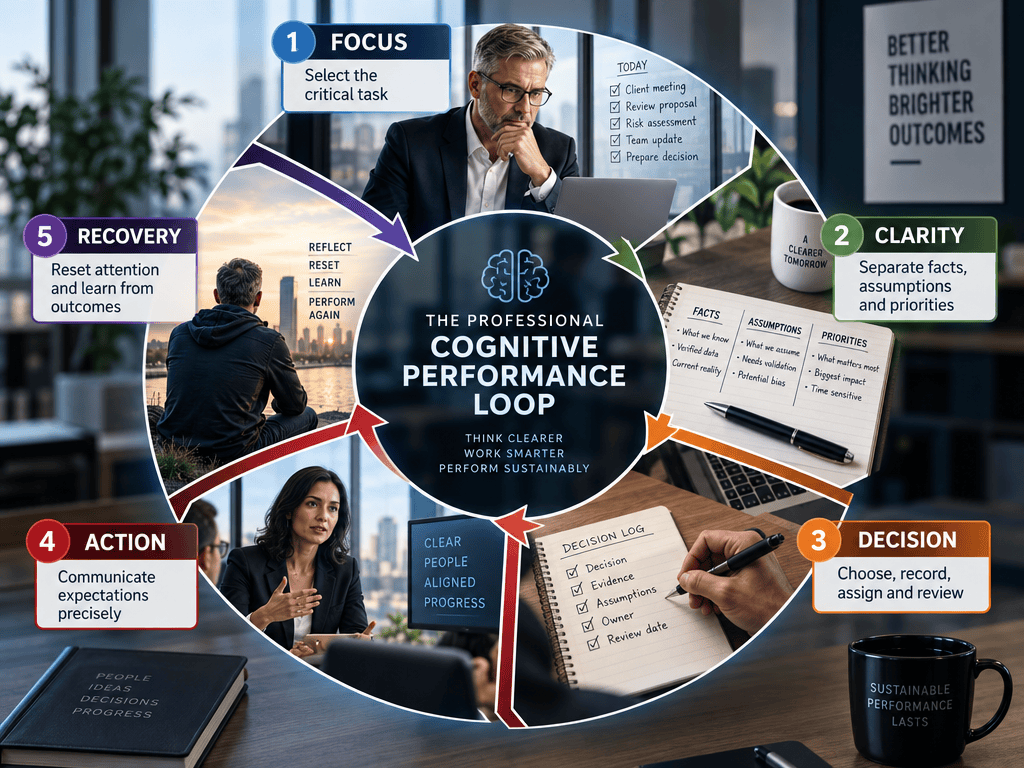
Selecting cognitive training tools with governance and intent
Procurement should begin with the performance problem, not the product category. If an HR and L&D team is responding to fragmented attention, define where fragmentation is affecting quality, risk, customer experience or leadership effectiveness. If the concern is poor decision-making, establish whether the issue is capability, authority, information flow, incentives or workload.
Then assess tools against four questions. First, is the intended behaviour clear? Second, can people use the tool in the flow of work? Third, can managers reinforce it without becoming coaches by default? Fourth, what evidence will show that the practice is improving performance?
Consistency matters. A proliferation of unrelated wellbeing applications, productivity systems and one-off talks can create choice without capability. A smaller set of shared practices, introduced with clear intent and reinforced through managers, is usually more valuable than an extensive but incoherent toolkit.
This is also where authorised delivery matters. Facilitators should work from a defined framework, use consistent terminology and understand the organisational application of the material. Personality may create an enjoyable session; it does not, by itself, create dependable learning transfer.
Turning individual practice into team capability
Tools become organisational capability when teams use them together. A decision template adopted by one manager is helpful. The same template used across a leadership group creates clearer handovers, more productive challenge and a common record of why choices were made.
The most effective starting point is often a bounded intervention around an immediate business need. A 90-minute briefing can establish a shared method, test it against live scenarios and give teams a practical language to use afterwards. Echelon Academy’s 90-minute briefings are designed around specialist themes including performance and sustainable work, leadership, AI and digital change, cyber resilience, communication, and inclusive workplace culture.
Briefings are not a replacement for deeper development where capability gaps are substantial. They are a disciplined entry point: sufficiently focused to fit operational constraints, but structured enough to create a basis for continued application. Follow-through should include a nominated owner, a small number of agreed behaviours and a review point after teams have used the tools in real work.
Leaders have a particular responsibility here. If they request rigorous thinking but reward instant answers, staff will learn that speed matters more than judgement. If they encourage recovery but routinely treat fatigue as commitment, resilience training will lose credibility. The operating environment must support the capability being developed.
Frequently asked questions
Are brain-training apps useful for professionals?
They can support engagement or practise a particular task, but their value depends on whether learning transfers into professional decisions, communication and sustained performance. They should sit within a wider development approach.
Which cognitive skill should organisations develop first?
Start with the skill most connected to a visible business problem. For many teams, this is attention control or decision clarity because both influence quality, risk and execution.
How long should cognitive training take?
Short, repeated practices often work well when they are tied to real work. More complex issues, such as leadership judgement or conflict management, may require workshops, practice and follow-up over a longer period.
Can cognitive training reduce workplace stress?
It can help professionals manage attention, prepare for pressure and recover more deliberately. It cannot resolve structural causes of stress such as excessive workload, unclear accountability or poor management practice.
How can HR measure whether the tools are working?
Measure behaviour and operational outcomes, not only attendance or satisfaction. Relevant indicators may include decision rework, meeting quality, escalation patterns, error rates, retention or feedback on managerial clarity.
Should cognitive training be the same for every team?
No. The core framework can remain consistent, while scenarios, tools and emphasis should reflect the team’s work, authority, risk exposure and pace of decision-making.
The most credible cognitive training does not ask professionals to perform differently only when a workshop is taking place. It gives them a disciplined way to think, decide and recover when the working day becomes demanding – which is precisely when capability is tested.


Leave a Reply