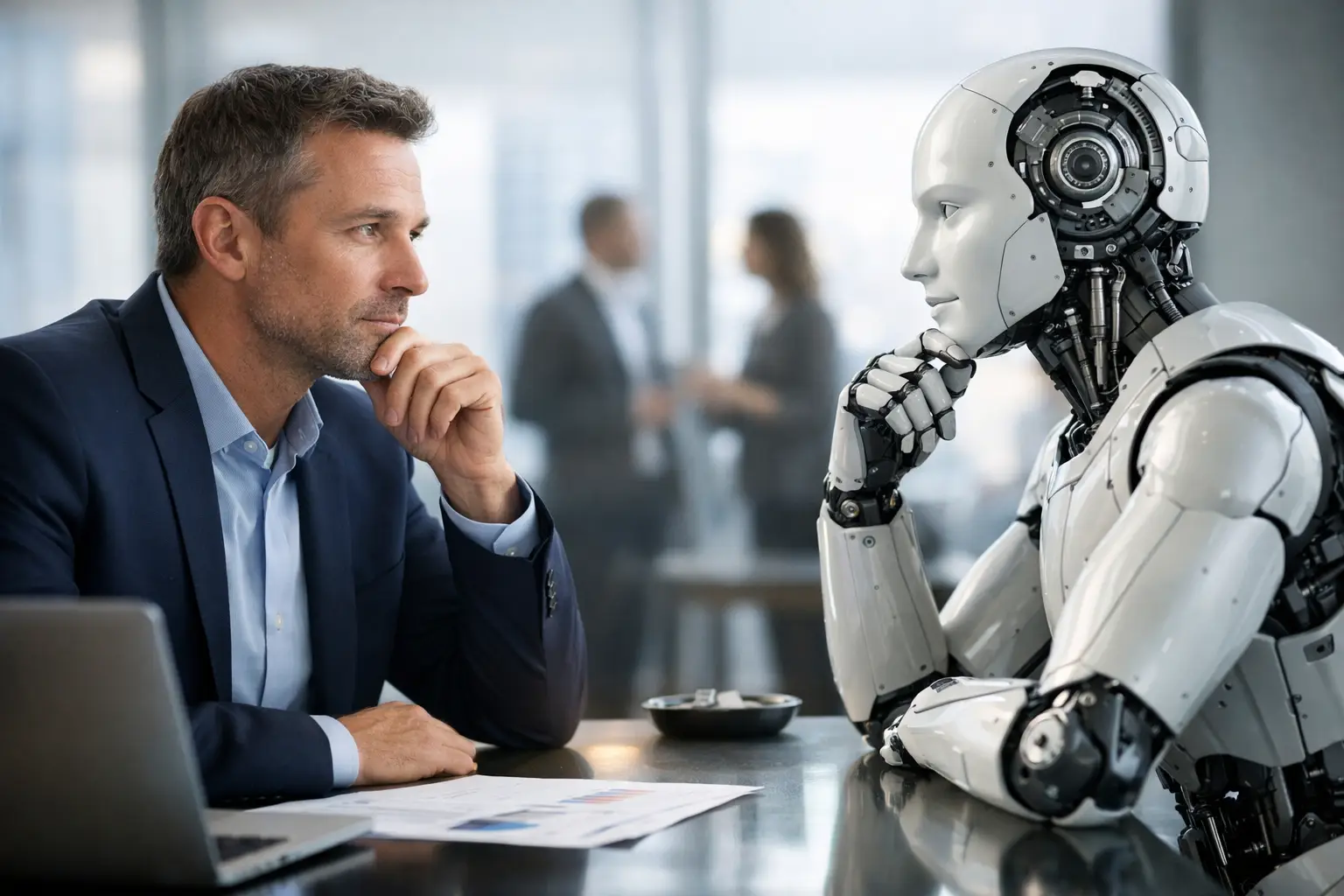
Featured image: A senior leadership team reviewing an AI-supported decision dashboard, with discussion and challenge taking place around the table.
By the AI, Digital Change and Transformation Faculty 7 September 2026
A recruitment shortlist is produced in seconds. A performance dashboard identifies a team member as an outlier. A workforce model recommends reducing headcount in one function and increasing it in another. The question is no longer whether these capabilities will enter management practice. They already have. The more consequential question is: can AI replace manager judgement when decisions affect people, performance, fairness and organisational trust?
For most organisations, the answer is no. AI can strengthen managerial decision-making, particularly where information is fragmented, patterns are difficult to see or routine analysis consumes unnecessary time. It cannot assume responsibility for the consequences of a decision, interpret the full human context, or provide the accountable leadership that employees reasonably expect.
Key Takeaways
AI is most useful when it improves the quality and speed of evidence available to managers, not when it is treated as an authority in its own right. Manager judgement remains necessary for context, challenge, ethical consideration and accountability. The practical objective is governed augmentation: clear boundaries around what AI may inform, what a manager must decide, and how decisions are reviewed.
Table of Contents
- Where AI adds genuine value to management decisions
- Why manager judgement cannot be automated
- Can AI replace manager judgement in high-stakes decisions?
- A governance model for AI-supported management
- Building management capability alongside technology
- Frequently Asked Questions
Where AI adds genuine value to management decisions
Management involves repeated decisions made under incomplete information. AI can materially improve this environment by processing large volumes of structured data, identifying patterns, modelling possible scenarios and highlighting inconsistencies that a busy manager may not see.
In workforce planning, for example, an AI tool may surface skills gaps by comparing business demand, available capability and likely attrition. In customer operations, it may identify rising pressure points before service levels visibly deteriorate. In performance management, it may reveal a trend across work allocation, absence or delivery data that warrants a manager’s attention.
This is useful because it changes the starting point of a conversation. Rather than relying solely on anecdote, recency bias or the loudest voice in the room, managers can begin with a clearer evidence base. The gain is not that the system has reached a verdict. The gain is that the manager has better questions to ask.
That distinction matters. A model may identify correlation without understanding causation. It can show that a team’s output has fallen, but it may not know that a key client changed scope, a new starter is still being trained, or a member of the team has been quietly carrying a disproportionate workload.
Why manager judgement cannot be automated
Judgement is not simply the ability to choose between options. It is the disciplined process of interpreting evidence in context, weighing competing duties, anticipating second-order effects and accepting responsibility for a decision. The more a decision affects an individual’s livelihood, dignity, development or safety, the less credible it becomes to outsource that process to a system.
A manager must often balance values that cannot be cleanly optimised. Should a high-performing employee be moved to a critical project when it may undermine their wellbeing? Is a decline in output a capability issue, a resourcing problem or a signal of conflict within the team? Would strict consistency create unfairness because two apparently similar cases are materially different?
AI can contribute information to these decisions. It cannot carry the relational and moral burden of making them. Nor can it establish trust through a difficult conversation, recognise when silence signals disengagement, or create the conditions in which a colleague can explain what the data does not show.
There is also a practical risk in treating AI output as neutral. Every system reflects choices about data, categories, objectives and thresholds. If historic decisions contain bias, if relevant data is absent, or if the model is calibrated around efficiency alone, the output may appear precise while reinforcing a flawed premise. Manager judgement is the control that asks whether the recommendation makes sense before it becomes action.
Can AI replace manager judgement in high-stakes decisions?
The closer a decision comes to employment status, reward, disciplinary action, promotion, redundancy, performance sanction or wellbeing intervention, the stronger the requirement for informed human oversight. In these situations, AI should not be the final decision-maker.
Consider a tool that flags employees as a retention risk. The indicator may help a manager prepare for a conversation, review workload or consider development opportunities. It should not become grounds for excluding somebody from a strategic project, questioning their commitment or making assumptions about their intentions. A prediction is not a fact about a person.
The same principle applies to performance data. A dashboard may show lower activity, slower completion rates or reduced client contact. A capable manager investigates the operating conditions behind those figures. They test the data, hear the employee’s account and distinguish between a temporary constraint and a sustained issue requiring action.
This does not mean leaders should reject AI to preserve familiar ways of working. It means they should apply proportionality. Low-risk administrative decisions may be substantially automated with appropriate checks. High-impact people decisions require a manager who understands the facts, can explain the reasoning and remains accountable for the outcome.
A governance model for AI-supported management
Effective use of AI requires more than a tool policy. It requires decision governance that managers can apply in live situations. A useful framework begins by defining the role of the system: is it summarising information, generating options, identifying risk, recommending action or executing a routine task? These functions carry different levels of organisational risk.
Next, establish decision rights. Managers need clarity on which decisions must remain human-led, when specialist review is required and when a recommendation should be challenged or paused. HR, legal, information security and operational leaders may all have a legitimate role depending on the application.
Organisations should also require traceability. A manager should be able to explain what information informed a significant decision, how AI was used, what human judgement was applied and why the final course of action was appropriate. This protects employees, supports consistent practice and creates an audit trail when decisions are scrutinised later.
Finally, teams need a route for escalation. If a manager believes an output is misleading, biased or unsuitable for the case at hand, they must be able to set it aside without being penalised for failing to follow the system. Governance is not blind compliance with a model. It is structured challenge in service of better decisions.
Building management capability alongside technology
The adoption gap is rarely caused by technology alone. It is caused by uneven management capability. Some managers will accept AI output too readily because it appears objective. Others will ignore useful evidence because they do not understand how to interrogate it. Both responses reduce value and increase risk.
Development should therefore focus on practical cognitive disciplines: framing the decision correctly, separating evidence from inference, identifying missing context, testing alternative explanations and recognising when a recommendation exceeds the system’s legitimate role. These are management capabilities, not technical extras.
For leadership and HR teams, short, structured interventions can be particularly effective when technology is changing faster than formal learning programmes can be redesigned. Echelon Academy’s 90-minute briefings are designed to give teams a shared language for issues such as AI, digital change, leadership judgement and responsible implementation. The purpose is not to make every manager a data scientist. It is to ensure that those responsible for people and performance can use new tools with consistency, integrity and intent.
A useful test is simple: if an employee asked, “Why was this decision made?”, could the manager explain the reasoning without hiding behind an algorithm? If the answer is no, the process is not ready for high-stakes use.
Frequently Asked Questions
Can AI make better decisions than managers?
AI can outperform people at narrow tasks involving large datasets, repeatable rules and pattern recognition. It does not automatically make better overall management decisions, because those decisions involve context, relationships, values and accountability.
Should managers use AI for performance management?
They can use it to identify patterns, organise evidence and prompt further investigation. Managers should not use AI output as the sole basis for performance ratings, sanctions or capability decisions.
Who is accountable when AI informs a management decision?
The accountable person remains the authorised human decision-maker. Introducing AI does not remove a manager’s responsibility to understand, challenge and justify the final decision.
Can AI reduce bias in management?
It can help identify inconsistent patterns or prompt more structured decision-making. It can also reproduce or amplify bias if its data, assumptions or deployment are poorly governed. Human review remains essential.
What decisions should never be fully automated?
Decisions involving dismissal, disciplinary action, promotion, pay, redundancy, wellbeing, discrimination concerns or material changes to an employee’s role should retain meaningful human involvement and review.
How can organisations prepare managers for AI-supported work?
Start with clear decision boundaries, practical governance and scenario-based learning. Managers need practice in questioning outputs, recognising limitations and communicating decisions responsibly.
The strongest management teams will not compete with AI by trying to process more information than a machine. They will distinguish themselves by applying sound judgement to the information that matters, particularly when the decision is difficult and the human consequences are real.

Leave a Reply