
[Featured image: A manager reviewing an AI-generated briefing alongside a governance checklist in a professional workplace]
By the AI, Digital Change and Transformation Faculty, Echelon Academy 19 August 2026
A manager pasting a difficult performance conversation into a public AI tool may save ten minutes and create a data protection issue. The same manager using an approved system to turn agreed notes into a neutral meeting structure may improve consistency and reduce administrative load. The question is not whether managers should use AI at all. It is whether they can use it with sufficient judgement, controls and accountability.
Can managers safely use AI? Yes, but only when the organisation treats AI as a managed workplace capability rather than a personal productivity shortcut. Safety depends on the task, the information involved, the tool’s controls and the manager’s ability to challenge the output before acting on it.
Key takeaways
- AI can support managers with preparation, drafting, analysis and routine administration, but it should not make people decisions.
- Personal, confidential, commercially sensitive and security-relevant information requires explicit controls before it is entered into any AI system.
- A manager remains accountable for the decision, even where an AI tool shaped the wording, options or analysis.
- Clear approval routes, practical training and documented use cases are more effective than a blanket instruction to “use AI responsibly”.
- The highest-risk uses usually involve recruitment, performance, absence, disciplinary action, pay, employee relations and decisions that affect access or opportunity.
Table of contents
- Why managerial AI use needs governance
- Where AI can add value with lower risk
- The decisions managers should not delegate
- A practical control framework
- Building managerial judgement, not dependence
- Frequently asked questions
Why managerial AI use needs governance
Managers work at the point where organisational policy becomes lived experience. Their emails set a tone. Their meeting notes shape records. Their decisions affect workload, progression, trust and, at times, employment status. Introducing AI into this work therefore changes more than efficiency. It changes the route through which judgement is formed and communicated.
AI systems can produce plausible language with striking confidence. That is useful when a manager needs a first draft, a concise summary or alternative ways to frame a message. It becomes hazardous when the output is mistaken for evidence, policy or professional advice. A polished answer may omit relevant facts, reflect biased assumptions or invent a source that does not exist.
In UK workplaces, the governance question also extends beyond accuracy. Managers may handle personal data, special category data, customer information, intellectual property and commercially sensitive plans. The safe position is not to assume that a tool is private because it sits behind a login. Organisations need to know what is entered, where it is processed, whether it is retained, and who can access it.
Where managers can use AI with lower risk
The most defensible starting point is administrative support using approved tools and non-sensitive inputs. AI can help a manager structure an agenda, create a first draft of a project update, turn generic source material into a training outline or suggest questions for a routine team review. It may also help identify gaps in a process document or make dense material easier to read.
These tasks still require review. A manager should check that the output is correct, appropriate to the audience and consistent with internal policy. The value is not in accepting the first answer. It is in reducing the blank-page problem while retaining professional control.
A useful test is whether the task can be completed safely with anonymised, generic or already approved information. If the answer is yes, the use case may be suitable for a controlled pilot. If it relies on individual employee circumstances, confidential commercial detail or a consequential judgement, the threshold should rise substantially.
Examples of proportionate use
A manager could ask an approved AI assistant to create a neutral template for a one-to-one meeting, provided no identifiable employee information is supplied. They could request alternative ways to explain a policy change, then verify the final wording against the policy owner’s approved material. They could also use it to generate draft action headings from their own non-confidential notes.
The distinction is straightforward: AI can assist the preparation of managerial work. It should not become the unexamined author of managerial action.
The decisions managers should not delegate to AI
AI should not determine who is hired, promoted, disciplined, placed on a performance process or selected for redundancy. Nor should it be used as the sole basis for assessing capability, absence patterns, conduct, potential or employee sentiment. These are high-consequence decisions shaped by context, evidence, policy, fairness and human explanation.
This does not mean AI has no role around these processes. It may help a manager understand a procedure, draft standard communications approved by HR or organise non-identifiable information. But the manager must not use generated text as a substitute for investigation, consultation or a properly reasoned decision.
There is a further issue: explainability. If an employee asks why a decision was made, “the system suggested it” is not an adequate answer. The manager and organisation must be able to identify the relevant evidence, explain the reasoning and demonstrate that policy and legal obligations were followed.
The manager’s AI decision gate
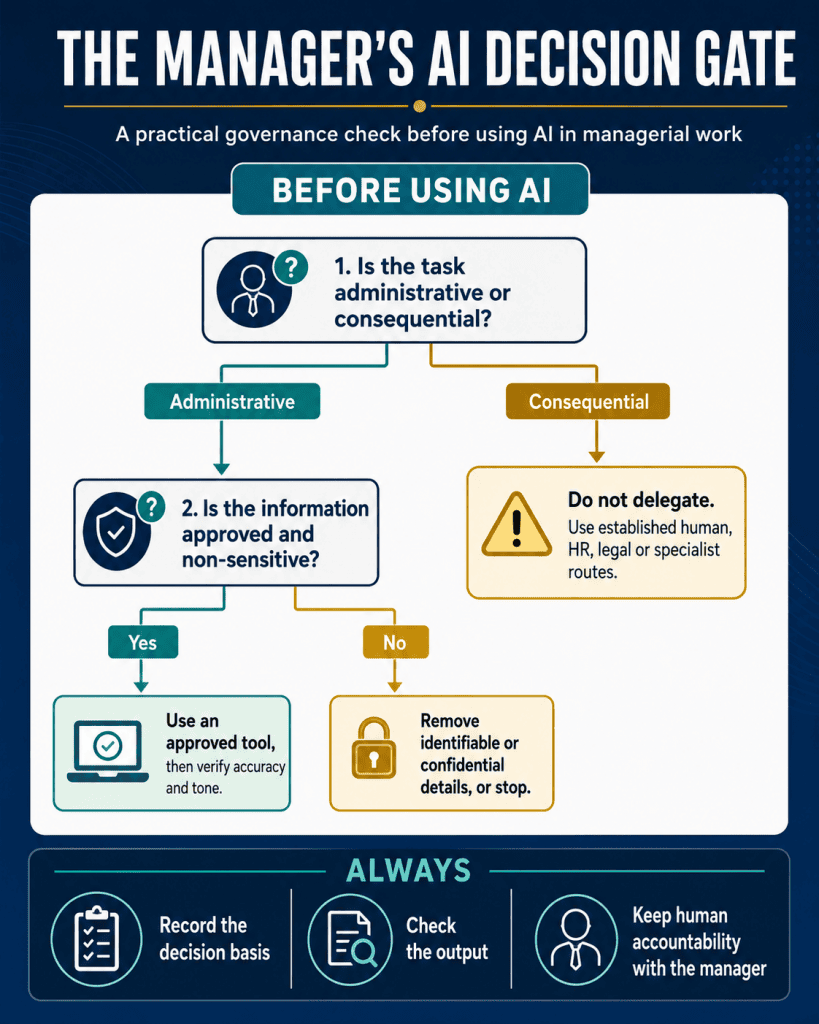
A practical control framework for safe use
A workable AI policy should be specific enough to guide action under pressure. Broad statements about ethics are valuable, but a manager deciding how to handle a sensitive employee issue needs clear boundaries in the moment.
First, define approved tools and approved use cases. This avoids the common position where staff are encouraged to innovate but have no reliable way to know which systems meet organisational requirements. Second, classify information. Managers should understand the difference between public information, internal material, confidential data and personal data, as well as the consequences of entering each category into an AI service.
Third, establish human review requirements. High-impact content should be checked by an appropriate person before it is shared or acted upon. The review should assess factual accuracy, bias, tone, policy alignment and whether the AI has introduced assumptions that were not present in the source material.
Fourth, create escalation routes. A manager should know when to involve HR, information security, data protection, legal advisers or a senior decision-maker. Escalation is not a sign that AI has failed. It is part of responsible use where the potential impact exceeds the manager’s authority or expertise.
Finally, retain a proportionate record for significant uses. Documentation should show the task, the tool, the information category, the review undertaken and the person who made the decision. This supports consistency, learning and auditability without turning every low-risk drafting task into a compliance exercise.
Building managerial judgement, not dependence
The greatest organisational risk is not simply poor AI output. It is managerial deskilling: the gradual habit of accepting concise, confident answers rather than thinking through ambiguity. Effective managers need to ask what the tool may have missed, whose perspective is absent and what evidence would change the conclusion.
That capability is best developed through scenario-based learning. Managers should practise distinguishing a low-risk drafting request from a high-risk people decision, challenge imperfect outputs and rehearse escalation conversations. A structured 90-minute briefing can provide a practical common language for teams beginning to use AI, particularly where HR, leadership, cyber resilience and digital transformation responsibilities overlap.
For Echelon Academy, this is a MindWorks PRO® issue as much as a technology issue. Focus determines whether managers notice a flawed assumption. Clarity determines whether they frame a task safely. Decision-making determines whether they treat an output as a prompt for judgement rather than a replacement for it. Sustainable performance requires each of those capabilities to hold under time pressure.
AI can make management work faster. It cannot make it accountable. Organisations that set clear boundaries and build practical judgement will give managers something more valuable than permission to experiment: the confidence to use AI with consistency, integrity and intent.
Frequently asked questions
Can managers use AI to write performance review comments?
They can use an approved tool to improve structure or clarity where information is suitably anonymised and the manager retains full authorship and judgement. AI should not generate an assessment of an individual’s performance from sensitive employee data or replace the manager’s evidence-based evaluation.
Can managers put employee information into AI tools?
Not without explicit organisational approval and appropriate safeguards. Employee information may be personal or special category data, and managers should follow the organisation’s data handling rules and approved-tool policy before using it.
Is AI safe for drafting sensitive emails?
It depends on the sensitivity of the issue and the information supplied. For routine communications, AI may assist with tone and structure. For grievances, disciplinary matters, health information, disputes or restructures, managers should use approved processes and seek specialist input.
Who is responsible if AI gives a wrong answer?
The manager and the organisation remain responsible for decisions and communications made using AI. A tool may support work, but it does not hold managerial accountability.
Should organisations ban managers from using public AI tools?
A blanket ban may reduce visibility without removing use. A stronger approach is to define prohibited uses, provide approved alternatives and train managers to recognise when a task requires human or specialist judgement.
What training do managers need before using AI?
Managers need practical instruction on data classification, prompt design, output checking, bias awareness, escalation and decision accountability. Training should use realistic workplace scenarios rather than generic demonstrations.
The right standard is not whether a manager can produce an answer quickly. It is whether they can explain, defend and improve the decision that follows.

Leave a Reply