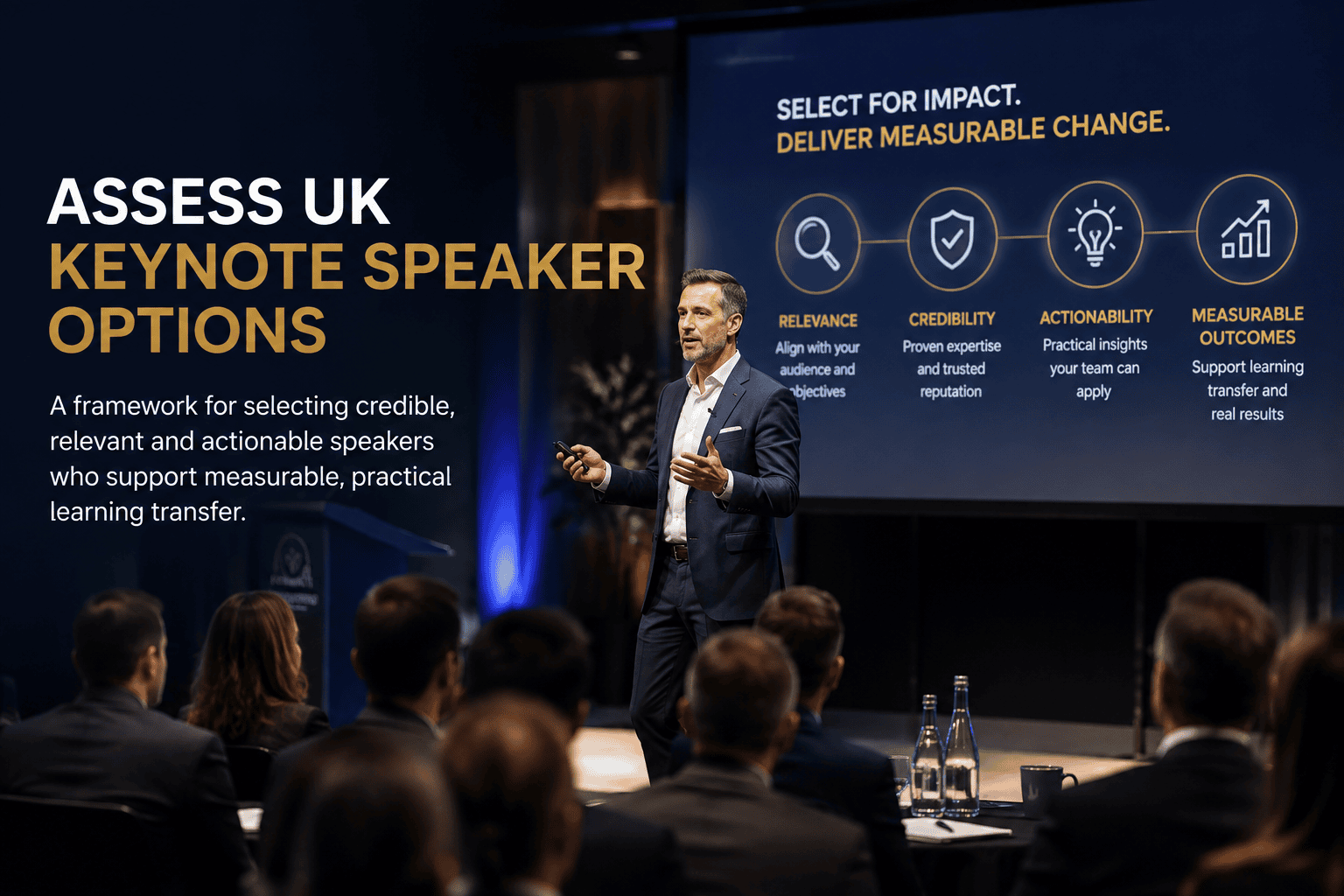
Featured image: A keynote speaker reviewing a structured event programme, with keynote selection criteria mapped against business priorities.
By the MindWorks PRO® Performance Faculty 16 August 2026
A keynote can set the intellectual standard for an event, or expose the absence of one. When considering UK keynote speaker options, the central question is not simply who will hold the room. It is whether the session will give people a credible shared language for decisions, behaviour and action once the event has ended.
For HR, L&D and leadership teams, this distinction matters. A polished personal story may create an immediate response, but it does not automatically support learning transfer. The stronger choice is usually a speaker whose subject expertise, delivery method and intended outcome have been designed around the organisation’s context.
Key Takeaways
The best keynote choice depends on the event’s job: alignment, challenge, capability building or cultural reinforcement. Selection should test relevance, intellectual substance and practical application together. For organisations seeking more than a one-off intervention, framework-led delivery offers greater consistency than a personality-led booking model.
Table of Contents
- What a keynote should achieve
- The main UK keynote speaker options
- How to assess speaker quality
- When a briefing is a better fit
- Designing for learning transfer
- Questions to ask before booking
- Frequently asked questions
What should a keynote achieve?
A keynote is often treated as a moment of energy within an agenda. That is too narrow. In a well-designed professional event, it should perform a defined organisational function.
It may establish a common understanding before a strategy session, sharpen thinking around a live business risk, give managers language for a difficult change, or create a disciplined opening to a wider learning programme. Each objective calls for a different form of speaker and a different degree of customisation.
The most useful brief is therefore not, “We need an inspirational speaker.” It is, “What must participants understand, discuss or do differently after this session?” A clear answer makes it easier to distinguish entertainment from a contribution that has operational value.
UK keynote speaker options: the main models
The market offers considerable choice, but the options tend to fall into a small number of models. None is inherently wrong. The appropriate model depends on the importance of the subject, the level of risk and what follows the event.
Celebrity and high-profile speakers
Well-known figures can bring attention, media interest and a memorable personal account. They can be particularly effective for a large awards evening, client gathering or event where visibility is part of the objective.
The trade-off is that recognition does not guarantee relevance. A compelling story from sport, politics or entertainment may not equip a management group to deal with conflict, decision quality or the practical implications of digital change. This route works best when the event needs profile and emotional resonance, rather than structured capability development.
Subject specialists
Specialists are selected for depth in a particular field, such as artificial intelligence, cyber risk, organisational culture or leadership. Their value is often strongest where an organisation needs a precise explanation of a changing issue and a credible interpretation of its implications.
However, technical expertise alone is not enough. A specialist should be able to translate complex material for the audience in front of them, without simplifying it into vague prediction or fashionable terminology. Ask how they will connect their expertise to the organisation’s decisions, governance and day-to-day practice.
Motivational speakers
Motivational speakers may be effective where morale, confidence or collective momentum is the principal need. The strongest practitioners can make difficult ideas accessible and stimulate honest reflection.
Yet motivation has a short half-life when it is not attached to a method. For teams working under sustained pressure, an event should ideally leave behind practical routines for focus, resilience, communication and judgement. Energy is useful; it is not a substitute for a repeatable approach.
Framework-led professional speakers
Framework-led speakers work from a defined body of principles, tools and learning outcomes. Their session is not dependent solely on individual charisma or anecdote. Instead, the audience is introduced to concepts that can be reinforced through workshops, courses, manager conversations and further development.
This model is especially suited to organisations that need consistency across divisions, leadership levels or a longer programme of work. Authorised practitioners deliver to shared standards, so the experience is more governable and less exposed to variation in style or interpretation.
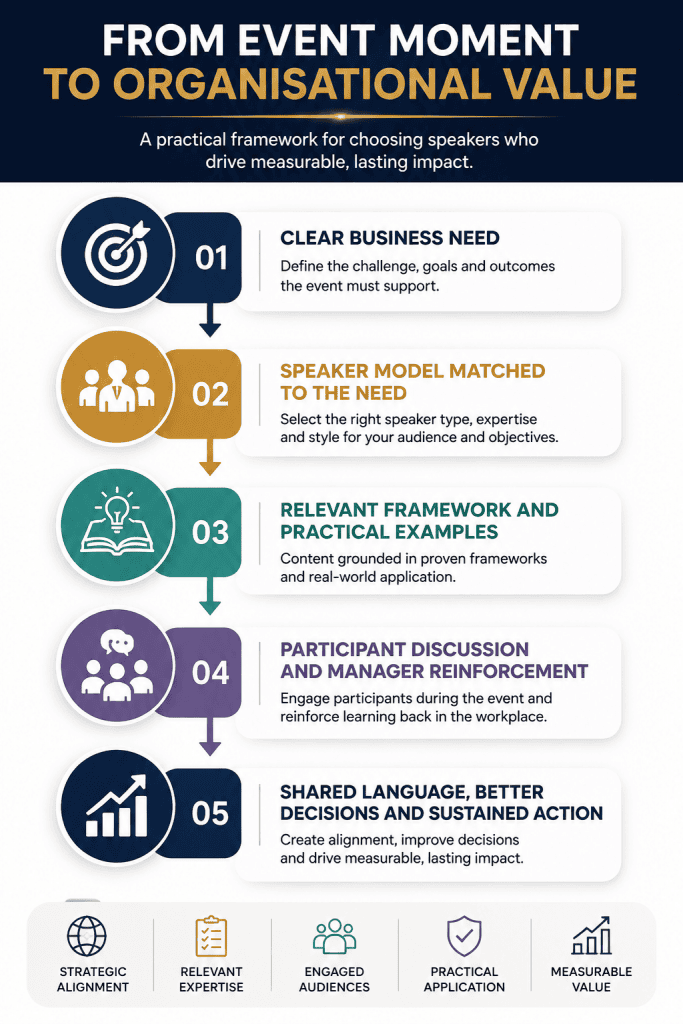
How to assess speaker quality beyond the showreel
A showreel can demonstrate confidence on stage. It rarely demonstrates whether a speaker can work responsibly with a complex brief. Evaluation should include the discipline behind the delivery.
First, assess whether the speaker can articulate a clear point of view. If the proposed session could be delivered to any audience with only the company name changed on the opening slide, it is unlikely to address a meaningful organisational need.
Second, examine the underlying method. Ask what framework, research base or professional practice informs the content. This is not a demand for academic performance. It is a test of whether the session has intellectual integrity and can withstand scrutiny from experienced professionals.
Third, establish how the speaker handles application. A high-value keynote should give participants a way to interpret their own work differently. This may be a decision framework, a leadership practice, a model for preparing difficult conversations or a set of prompts for managing attention under pressure.
Finally, consider delivery governance. Who is responsible for quality assurance? How is the brief captured? What happens if the session needs to be extended into workshops or smaller team sessions? These questions are often more revealing than testimonials alone. The MindWorks PRO® Speaker Panel deliver framework-led keynotes and symposium sessions designed for corporate, professional, education, and high-accountability environments across the UK.
MindWorks PRO® is the intellectual framework that underpins all Echelon Academy activity.
It provides a structured approach to focus, clarity, decision-making, resilience, leadership, and sustainable professional performance.
When a 90-minute briefing is the better fit
Not every business issue requires a conventional keynote. Where the objective is focused awareness and usable direction, a structured 90-minute briefing can be more effective than a broad, auditorium-style presentation.
This format gives teams sufficient time to understand the issue, test its relevance and identify immediate implications, while respecting demanding diaries. It can be particularly valuable for six recurring areas of organisational pressure: AI and digital transformation; HR and leadership; cyber resilience; sustainable performance; communication and professional presence; and inclusive workplace culture.
Echelon Academy’s 90-minute briefings are designed around these themes as concise, framework-led interventions for leadership and HR teams. They are appropriate where an organisation needs a credible starting point that can later develop into deeper learning, rather than a single event moment with no route to application.
Design the event for learning transfer
The keynote should not be planned in isolation. Its value increases when the agenda gives people an opportunity to process, discuss and use what they have heard.
A short facilitated conversation immediately after the session can help teams identify where the ideas meet current practice. Managers should receive a small number of follow-up questions, not an oversized toolkit that remains unopened. If the keynote introduces a framework, use its language in subsequent workshops, leadership meetings and development materials.
This is where consistency, integrity and intent become commercially significant. Participants do not need another disconnected initiative. They need a coherent experience that helps them make better choices in the situations they already face.
Questions to ask before booking
Before confirming a speaker, establish the primary outcome for the event, the audience’s existing knowledge, the degree of organisational specificity required and what reinforcement will happen afterwards. Also ask whether the speaker is comfortable being challenged by senior participants and how they will handle contested issues or sensitive questions.
The right choice may be a recognised name, a technical specialist or a framework-led practitioner. It depends on the purpose. What should not vary is the standard of thought applied to the decision.
Frequently Asked Questions
What is the difference between a keynote and a corporate talk?
A keynote usually carries greater strategic weight within an event. It sets a theme, perspective or agenda. A corporate talk may be shorter, narrower or positioned as one contribution among several.
How far in advance should we book a keynote speaker?
For an important leadership event, begin the selection process several months ahead. This allows time for proper briefing, agenda design and appropriate customisation. Shorter notice can work, but it reduces planning options.
Should a keynote be tailored to our organisation?
Usually, yes. Tailoring does not mean inserting a company logo into generic slides. It means connecting the speaker’s framework and examples to the audience’s role, current pressures and intended outcomes.
Are celebrity speakers worth the investment?
They can be, where profile, attendance or a distinctive personal story are central to the event. They are less suitable when the priority is building a common professional capability across teams.
Can one keynote support a wider learning programme?
Yes, provided the content is built on a coherent framework. The keynote can introduce the language and principles, with workshops, briefings or manager-led activity providing the repetition needed for practical adoption.
What should HR and L&D teams measure afterwards?
Measure against the event’s original purpose. Useful indicators may include participant understanding, quality of follow-up discussion, manager observation of changed practice and uptake of subsequent learning activity.
The most worthwhile speaker decision is the one that leaves people better equipped for the work awaiting them on Monday morning.


Leave a Reply